
The somber image of uniformed military personnel approaching a home to deliver news of a soldier’s death has become an indelible and poignant symbol in American society.[1] This act of commemorating fallen warriors has become synonymous with the U.S. Army Chaplain Corps and the competency of “Honor the Fallen” that characterizes it.[2] The practice of in-person Next of Kin (NOK) notification is actually a relatively recent development, as is the chaplain’s role in accompanying the notification officer. I trace the historical development and key factors that solidified the commitment to in-person notifications, from the Revolutionary War to the present. NOK notifications have not always been an integral part of the Army or the Chaplain Corps. Looking to the future, I suggest that chaplains must be agile, adaptable, and creative in the adoption of future notification programs in the next war.
While the focus of this paper is on NOK notifications, the absence of a formal notification system prior to the 1960s makes it important that I comment on burial practices. NOK notifications evolved from differing perspectives on death itself, which coalesced into the demand for a more personal grieving experience. Exploring the foundations of this is critical to the role of chaplains in Honoring the Fallen and how this Corps Competency changed over time with the culture. While I briefly discuss burial practices, especially from the Revolution War to the Civil War, more robust research and attention must be developed, especially in how it will function in future Large-Scale Combat Operations (LSCO).
Early Conceptions: The Pragmatism of Battlefield Death in the Revolutionary War
Most who perished during the Revolutionary War were not afforded the right of a funeral, nor were there any official processes to notify the family of the deceased.[3] Common sense seemed to prevail, whereby bodies were laid to rest expediently as military operations dictated.[4] Robert Selig, a leading expert in death during the Revolutionary War, comments that “people were buried wherever they were found.” There were no norms for military burials or communication with loved ones left behind.[5] Due to the primitive nature of communication, family members were notified by letter, especially if the deceased was known by other men or by their commanding officer, and grave locations were sometimes kept by commanding officers or by the local populace.[6]
Chaplains played a very small role concerning the dead in the Continental Army, a far cry from today’s U.S. Army Chaplain Corps’ call to “Honor the Fallen.” Three ideas support this. First, it was outside of the conception of the American chaplain as George Washington envisioned. His support for chaplains in the Continental Army stemmed from encouraging morality and providing for the free exercise of religion in religious services.[7] Their role sometimes included funerals, but these were the exception. Second, the culture viewed death differently than we do today. The Ars Moriendi, “The Art of Dying,” were two Latin texts, developed in the 14th century, that explained how to die well, or what was included in the “good death.” The good death was associated with how to give up one’s soul “‘gladly and wilfully’; how to meet the devil’s temptations of worldly attachments; how to pattern one’s dying on that of Christ; and how to pray,” and would become the preoccupation of Americans in the eighteenth century from nearly every religious background.[8] Death was “accepted as a commonplace if harsh reality to be followed” by heaven, which was to be entered in the presence of family.[9] Moreover, especially for Protestants, the world was a “wilderness” and as sojourners longing for an eternal home, the trial they endured in this life was considered temporary.[10] Undergoing the good death did not necessarily require the presence of clergy, especially in wartime.[11] The pragmatism of the military operations of the Revolutionary War meant chaplains were not always able to undertake duties accentuating the faith of the deceased.[12] Notifying the decedents’ family was not possible given the time, distance, human capital, pressing military operation, nor was it demanded. At this moment in history, the chaplain’s initial role was not to engage in the honoring of the fallen during the Revolutionary War period.[13]
A Shifting Cultural Paradigm: The Civil War and the Seedling of Formal Casualty Processes
Toward the middle of the nineteenth century, tectonic changes in American culture occurred. Innovative philosophical discourse changed perceptions about the dead, death, and dying. There came a desire for loved ones to know when and how their loved ones departed and, in some cases, had the urge to unearth their remains for a proper burial in times of war. The Civil War coincided with these shifts. The case of William Marton Gable is interesting and instructive in terms of how the war and the shifts informed notification and burial practices. Thomas Patterson, Gable’s chaplain, wrote his mother a letter stating her son had perished in combat.[14] In response, Gable’s sister wrote back on whether it would be possible to find her brother’s remains so she could bury him with dignity.[15] This account demonstrates the marked shift in thinking: where in one era, the bodies of soldiers were to be buried pragmatically and efficiently, in another it was of supreme importance to find and properly dispose of the remains.
It is of little surprise, then, that the role of the chaplain morphed to account for these cultural changes. Civil War chaplains engaged in funerals more often than their predecessors. The typical arrangement was for the remains to be preserved in a wooden box and then buried in the ground.[16] Chaplains, as has been demonstrated in the Gable account, also played a part in notifying families of the dead, mostly by writing a letter, although no official Army policy guided or directed these efforts.[17] Further changes were spurred at the conclusion of the war that reflect Americans’ changing relationship with death. In 1862, Congress authorized the purchase of national cemeteries and in 1886, the Quartermaster General’s office was tasked with looking after the physical remains of Union soldiers with General Order No. 75 and Special Order No. 75, which read:
It is hereby ordered, that whenever any soldier or officer of the United States Army dies, it shall be the duty of the commanding officer of the military corps or department in which such person dies, to cause the regulations and forms provided in the foregoing directions to the Quartermaster General to be properly executed.[18]
The resulting organization was called the “Graves Registration Service,” (GRS hereafter) which operated for the first time at Fort Stevens in 1864.[19]
The outcome of these advances made it possible to not only accurately identify human remains, but also to categorize them. These advances were seen in the Spanish-American War, where lists of the dead were written down and kept for record.[20] Furthermore, the Spanish-American War saw the first signs of demanding the notification of NOK. Emerging communications technologies such as the telegram conveyed information rapidly with little human resource sacrificed. Writing to Washington, D.C. from San Francisco in October 1898, F.W. Lawrence remarks:
We receive dozens of inquiries every day from mothers and fathers of Philippine troopers. They are almost crazed by the uncertainty. Can you not induce the War Department to get by cable list of dead to date and have daily list cabled hereafter the same as from Cuba? That would be a small favor for the Government to render the families of its volunteer soldiers.[21]
This nascent arm of the Army would become the cradle for the system of notifying NOK in the modern era.
Forging a Corps Value: World War I and the Genesis of Modern Mortuary Affairs
Chaplains would come to be an integral part of this revolution, as seen in the life of Chaplain Charles C. Pierce. After distinguishing himself in Cuba as an innovator in mortuary affairs, Pierce developed a system that “dramatically improved the management of Soldiers’ remains.”[23] Utilizing lessons learned from the Spanish-American War, he recommended that “all men should wear [ID tags] as a military duty than one should fail to be identified,” something that was prominently enforced by World War I.[24] Furthermore, with the American involvement in World War I in 1917 the GRS mission encountered the complexity of burying remains of deceased soldiers in a foreign country and the potential for mass casualties on a daily basis.[25] Chaplain Pierce was at the forefront of innovations to address these uncertainties. He was appointed as a colonel to run the GRS, which saw its own set of changes to adapt to the current conflict. The GRS had six basic commitments, one of which included notification of the NOK. While this was a loose requirement, the GRS mandated that the NOK of the deceased were to be notified of the soldiers’ death, with photography and survey of cemeteries and graves.[26]
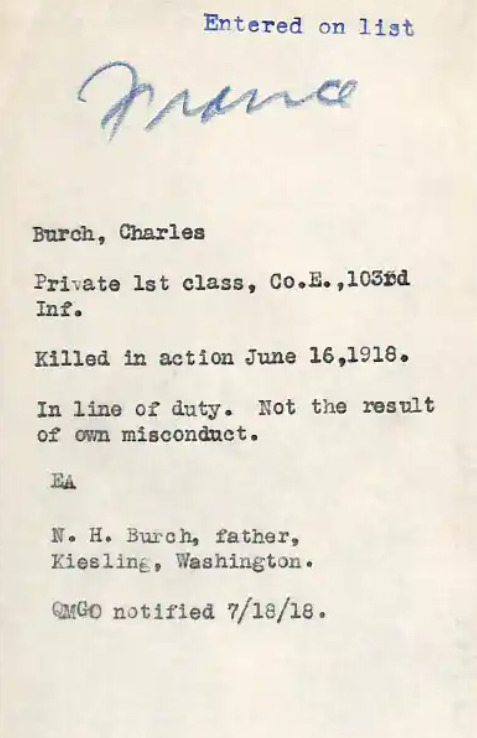
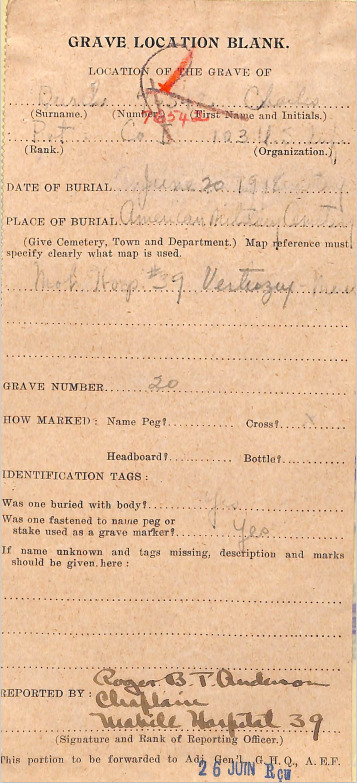
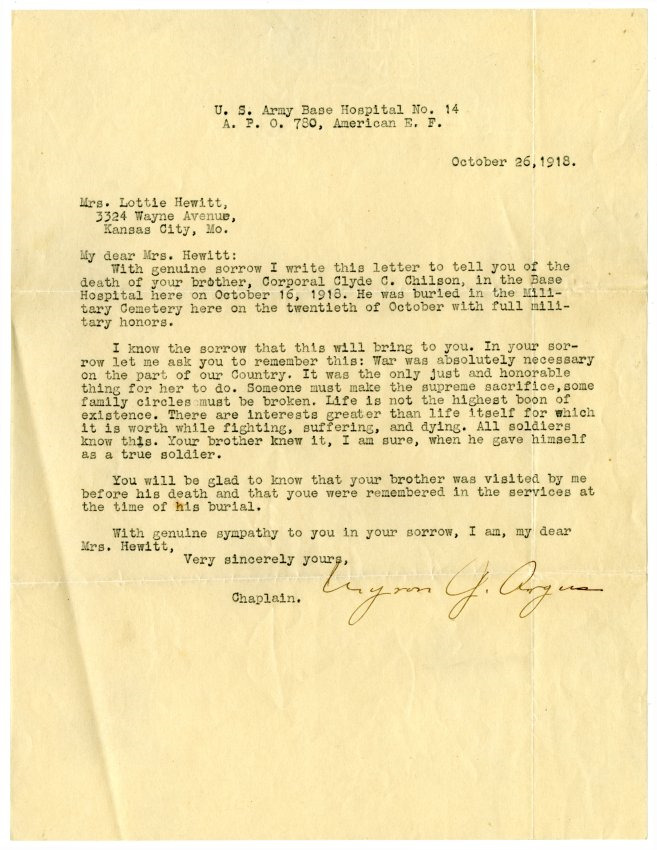
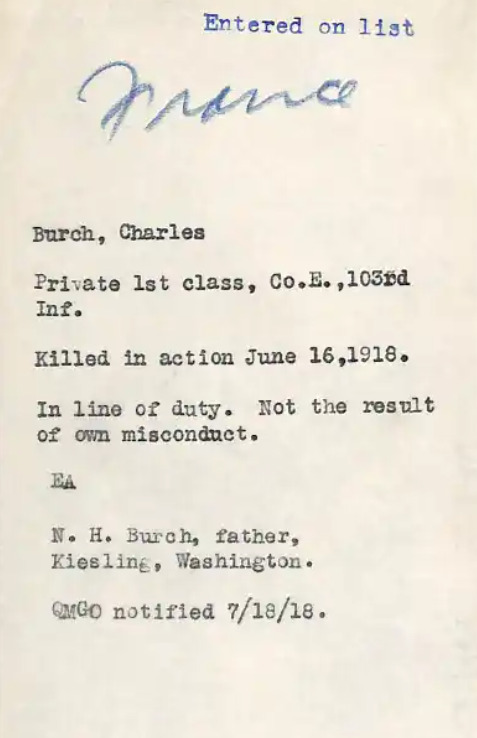
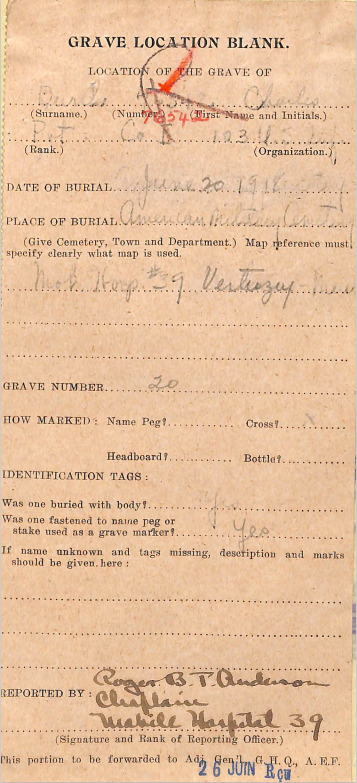
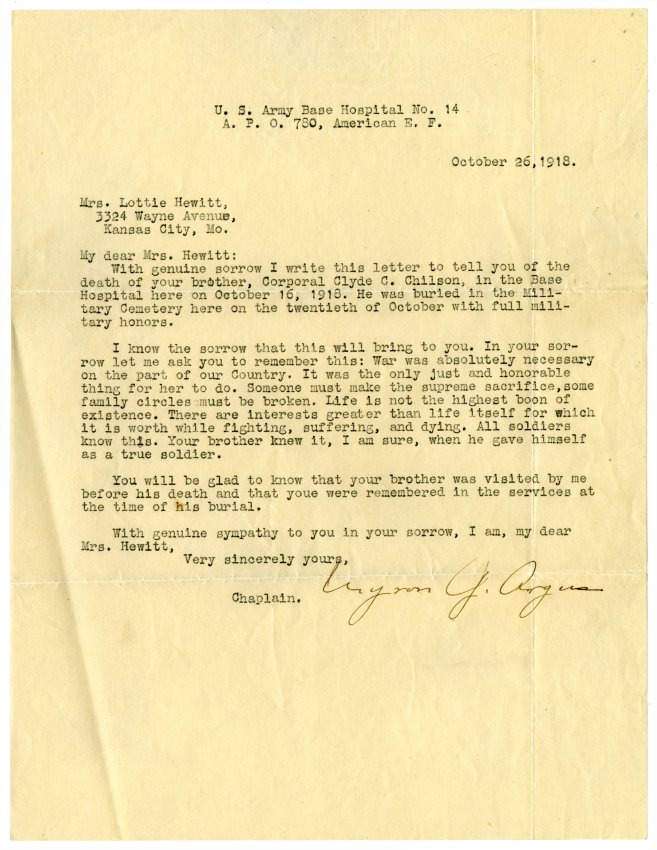
Practically, this meant the Army saw the notification of family members as its responsibility. Telegrams abound from the Great War that notified families of soldier casualties (See Figure 1). Chaplains seemed to play two key roles in this process: first, they often took it upon themselves to personally write to families when soldiers under their spiritual care died in combat (See Figure 2). Second, when chaplains were present for funerals/burials, they acted as reporting officers for a form entitled “Grave Location.” These forms were filled out, when possible, by the chaplain as the officer-in-charge for marking grave locations, information which was then passed onto the family (See Figure 3). The legacy Chaplain Pierce imbued on the GRS was most likely the impetus for the Corps’ charge to, “Honor the Fallen.” Historian Kyle Hatzsinger says in his PhD Dissertation, “Democracy of Death”:
Much of the GRS’s success during and immediately following World War I should be contributed to Colonel Charles Pierce. His knowledge, experience, and well-known compassion toward both the dead and their bereaved families made him the perfect choice to head the organization and influence its values from the beginning. The determination to locate, identify, and properly honor the war dead are traits still present in Mortuary Affairs teams to this day.[27]
The inter-war period between WWI and World War II saw the promulgation of Army Regulations that guided future policy. The AR 30 series of 1924 provided the official establishment of a GRS during war and sufficient procedures for burial.[30] While AR 30-1815 standardized reports of burials, it did not sufficiently address how the NOK should be notified.[31] AR 30-1815 would become the interwar standard, only changed after the hard lessons learned in 1944.
Technological Advancements and Evolving Expectations: Next of Kin Notification in World War II
America entered World War II in 1941, and the GRS experienced a steep learning curve as casualties began to mount. Historian Edward Steere, who compiled a complete history of the GRS in World War II, comments: “During the first 8 months of hostilities, the accomplishments of the Quartermaster General in organizing a graves registration service undoubtedly fell short of those expectations that had been written in Army Regulations 30-1805 and -1810 of 1924.”[32] Similarly, notification of a soldier’s death to the NOK was virtually nonexistent. Edward Steere writes that “kinsfolk of the fallen were thus compelled to rely on whatever unofficial information could be gathered from letters written by a comrade of the deceased or by some thoughtful company commander or devoted chaplain.”[33] Further, the Quartermaster General’s office was inundated with the request from NOK, “tell me about my boy.”[34] Thus, out of the cacophony of confusion and the desire to properly inform the NOK, a special board of officers were convened which recommended the following: the Casualty Branch will notify the NOK via letter, which will contain as much information as operational security allowed.[35] This manifested itself into AR 600-550, dated March 28, 1944, which described similar procedures.[36]
Especially ingenious was the development of new technologies that aided the response time and accurate notification of the NOK. This worked as in previous eras with the casualty report, filled out in theater and on-scene, which was then forwarded to the Quartermaster General. A punch card was inserted into an “IBM machine,” which printed a standardized notification that required variable information (e.g., name, rank, etc.) to be typed via hand onto a notification telegram. This was then forwarded to the NOK.[37] The process allowed massive dispatches to be disseminated across America without a lag in reporting.[38]
On October 3, 1944, all commanders in theater were ordered to write follow-on condolence letters to NOK.[39] These letters could be tasked down to hospital personnel or chaplains.[40] Additionally, the names of hospitalized personnel were required to be submitted by name once every 15 days, and progress report letters were sent to NOK.[41] Chaplains were also involved in this, as the “Chief of the Casualty Branch, the Chief of Chaplains, and the Surgeon General collaborated to see that such postal cards were sent regularly as long as the person remained on the seriously ill list.”[42] Chaplains were involved in NOK notification as expert letter-writers until hostilities ceased.
The NOK notification process saw tremendous modernization during World War II. Nearly 7,000 families daily could be notified of the casualty or death of their loved one because of technological advances. The strength of this system was expedient notification to NOK while limiting the manpower needed to conduct in-person notification.
The Catalyst for Transformation: The Vietnam War and the Birth of Modern Casualty Assistance
The modern casualty assistance programs were forged during the Vietnam War. The tumult of the 1960s provided the cultural seedlings for radical transformation of mortuary affairs, which came to fruition at the hands of Mrs. Julia Moore, spouse of Lieutenant General Hal Moore. According to Army sources, Moore prompted Army leadership to alter the then-normal practice of sending telegrams to families of the deceased.[43] Instead of taxi cabs delivering NOK notifications via telegram, Moore is said to have delivered them in person to the wives of deceased soldiers on Ft. Benning, Georgia from 1965-1966. Her complaints to the Pentagon about this callous system resulted in Department of the Army Pamphlet 600-19, which was a “60 day trial test” on the “feasibility of adopting a system throughout the Army of military notification of next of kin of Active Army casualties.”[44] The trial turned into doctrine, with the publication of AR 600-60: Personal Notification of Primary Next of Kin of Deceased and Missing Persons. In this regulation, those delivering the notifications should be officers whenever “practicable,” but also includes those in grades E-7-E-9 and should deliver the news of a loved one’s death in-person.[45] Chaplains are not specified as a central aspect of the notification, although they were present during the early NOK notifications.
The events of the 1960s and the vast change in the public’s perception of the duties of the Army to notify kin would forever alter the landscape of mortuary affairs. In the aftermath of Vietnam War, Michael J. Allen writes that an unprecedented search for the bodies of American service members commenced. He concludes “And while each of these wars [the Spanish-American War, the Civil War, World War I, World War II, and the Korean War] was followed by attempts to find, identify, and bury the dead, nothing so extensive as the post-Vietnam accounting effort had ever been attempted in the history of warfare.”[46] He concludes, “talk about lost warriors became a way to talk about a lost war, and the effort to account for them was as much a means to establish accountability for their loss as it was a search for their remains.”[47] This thesis bleeds into the “duty” of notification. Notification took on the added valence of American accountability for the death of service members.
The Contemporary Framework: Structure and Chaplain Integration in the Current Notification System
This sense of duty to the fallen warriors in the post-Vietnam War era characterizes current methodologies and doctrine of NOK notification. This system is based on the past decades of lessons learned. The successor to GRS was named the Casualty and Mortuary Affairs Operations Division (CMAOD) in 1991.[48] Structurally, CMAOD contains a headquarters element and three principle branches: Casualty and Mortuary Affairs Branch (CMAB), Policy and Training Branch, and Past Conflict Repatriations Branch.[49] Notifications are the responsibility of the CMAB, which is decentralized into Casualty Assistance Centers (CAC) located throughout the world, with over 30 in the Continental United States.[50] Casualties are submitted through the Defense Casualty Information Processing System (DCIPS, a web-based casualty reporting system) which informs the CMAOD.[51] The CMAOD alerts the regional CAC who, within 12 hours, designates a Casualty Notification Officer (CNO) to inform the family between the hours of 0500-2400.[52]
According to AR 638-8, the CNO will be accompanied by a chaplain (something that is not specified in AR 165-1).[53] The CAC works with CMAOD to find a chaplain to assist the CNO, while supervisory chaplains from the Army National Guard (ARNG) and United States Army Reserve (USAR) are the points of contact where gaps between CACs exist.[54] Should a chaplain not be available for a notification, or if “there is significant risk the notification requirement of 4 hours will not be met,” the CAC should “call [CMAOD] immediately.”[55] Accordingly, the CAC will notate why the chaplain did not accompany the CNO in DCIPS, as well as provide a detailed account of the circumstances in the After Action Report.
The ARNG and the USAR are instrumental at points of friction where chaplains may not be available during NOK notification missions. DA PAM 638-8 outlines a process that mitigates risk from failure of the chaplain to accompany the CNO, which include: a roster of Chaplains and their information; a state map of chaplains by place of residence; a roster of other Service chaplains by place of residence (especially where Active Duty/ARNG/USAR coverage is limited); rosters that will be updated quarterly; and annotation of chaplains who have volunteered to react on short notice for emergency situations.[56]
Navigating Future Conflicts: Reassessing Next of Kin Notification in Large-Scale Combat Operations
In-person NOK notification, particularly with the integrated presence of a chaplain, is a relatively recent development in the history of U.S. mortuary affairs operations. While deeply ingrained in the post-Vietnam War ethos and reflective of a commitment to the U.S. Army Chaplain Corps competency of Honoring the Fallen, the current system was conceived and refined within the context of counter-insurgency operations characterized by comparatively lower casualty rates than anticipated in future LSCO. The question, therefore, is not whether the current system is compassionate, but whether it remains feasible in the face of potential mass casualties in a conflict with a peer or near-peer adversary.
As an example, the III Corps Chaplain Directorate published a series of articles based on Warfighter Exercise 23-4, a LSCO-centric exercise. According to the data, the cumulative daily killed in action (KIA) was nearly 80, on par with the dead in World War I and World War II, but drastically lower than the 15 per day of Vietnam and 1 per day of the wars in Iraq and Afghanistan.[57] Edrena Roberts remarks, “the comparison shows U.S. Army has not seen daily casualties at 82 KIAs and 267 WIAs [wounded in action] per day since World War II.”[58] The conclusion is obvious: “the current method of casualty notifications will result in detrimental failure if the U.S. engages in a multi-domain conflict against a near-peer or peer adversary in a LSCO environment.”[59]
The ongoing Russia-Ukraine War provides a sobering glimpse into the realities of high-intensity conflict. Army medical planners estimate 3,600 casualties per day in a future LSCO conflict drawing on estimates coming from the Russia-Ukraine War.[60] For comparison, the last two decades of war during counter-insurgency operations resulted in around 50,000 casualties in total.[61] In a future conflict, hasty burials and grave markers may well replace ramp ceremonies and in-person NOK notifications, and perhaps the return to foreign soil burials seen in World War I and World War II. The expectation of immediate, in-person NOK notification, while deeply valued, may become a practical impossibility. This necessitates a critical re-evaluation of what constitutes responsible and respectful engagement with the families of the fallen in such demanding circumstances.
Alternative approaches to notification may need to be considered. Expedient communication, leveraging available technology for timely updates while acknowledging the limitations of in-person visits for every family, could become a necessary adaptation. In times of total war, capitalizing on civilian clergy or retired chaplains may also be a viable alternative to the current system. Furthermore, the historical record reminds us that honoring the fallen extends beyond the initial notification. Robust systems for the identification and dignified burial of remains (e.g., WWI era cemeteries in Europe or other methods of preserving remains for repatriation stateside), coupled with comprehensive and ongoing support for grieving families, might represent a more scalable and ultimately more impactful approach in a high-casualty environment. The challenge lies in adapting our deeply held values to the potential realities of future conflict. The U.S. Army and U.S. Army Chaplain Corps should begin to plan now to ensure that the commitment to “Honor the Fallen” remains central, even if the methods of initial notification must evolve.
My special thanks and gratitude to Russell “Rusty” Rafferty, reference librarian, Ike Skelton Combined Army Research Library, for his assistance in finding many of the citations of this article. Additional thanks goes to Lieutenant Colonel M. Patrick Stallings (1st Squadron, 4th Cavalry Regiment, Armor, Commanding) who provided the inspiration for this article.
Department of the Army, Army Regulation 165-1: Army Chaplain Corps Activities (Washington, DC: Department of the Army, 2024), 2-4.
The most famous Army manual of the Revolutionary War, Von Stueben’s “Blue Book,” does not speak to proper burial etiquette and no document establishes standard operating procedures of either burials or notifications. According to Robert Selig and Wade P. Catts, most were buried in pits with little fanfare during the heat of combat and as expediently as possible to avoid the stench and purification of bodies. See their “In the Morning We Began to Strip and Bury the Dead: A Context for Burial Practices During the American War for Independence,” Fields of Conflict, vol 3 (2019): 82.
John Smith, 1777 via Selig and Cates, “In the Morning.”
Robert Selig, “Revolutionary War Burials” (American History Television, C-Span, Washington D.C., October 10, 2018), 39:31-36; 44:32-49:59. Much of this discussion seems context dependent (e.g., location, weather, how much time was available, who controlled the battlefield, surrounding community, etc.), as Selig notes, sometimes officers were buried in the same manner as enlisted. See Selig and Cates, "In the Morning, 84, 86.
Selig and Cates, “In the Morning,” 86.
See George Washington Papers, Series 4, General Correspondence: Daniel Roberdeau to George Washington. 1777. Manuscript/Mixed Material. Https://www.loc.gov/item/mgw447311/: “This new and honorable Establishment is designed to suppress the horrid sins of cursing, swearing, and other vices with which, I am sorry to say, our Army vies with the most abandoned of the English troops; to strengthen the Officers hand by public and private exhortations to obedience of General and Regimental Orders; to discourage desertions by recommending the service; to encourage enlistments; to recommend cleanliness as a virtue conducive to health, and to reprehend the neglect of it.” Similar sentiments are found in Gen Washington’s other correspondence. C.f. John Whiting, Revolutionary orders of General Washington, issued during the years 1778, '80, '81, & '82, ed. Henry Whiting (New York and London: Wiley and Putnam, 1844), 75.
Drew Gilpin Faust, This Republic of Suffering: Death and the American Civil War (New York: Alfred A. Knopf, 2008), 3.
Gary Laderman, The Sacred Remains: American Attitudes Toward Death, 1799-1883 (New Haven: Yale University Press, 1996), 299-300.
Laderman, The Sacred Remains, 299-300.
For instance, Sergeant “Chaplain” Jesse Lee, a Methodist minister, stated his “extra duties” as acting Chaplain included “[going] among them where they lay in barns, at the point of death, and talk[ing] to them about their souls; and begged them to prepare to meet their God. When convenient, I attended the funeral of those who died, and prayed at the grave.” See Parker C. Thompson, United States Army Chaplaincy—From European Antecedents to 1791 (Washington, DC: Office of the Chief of Chaplains, 1978), 199.
This is not to say Chaplains were never involved in funerals. See Caroline Cox, A proper Sense of Honor: Service and Sacrifice in George Washington’s Army (Chapel Hill, NC: The University of North Carolina Press, 2007), 173-198. She uses the term funerals with “full military honors,” which seems to suggest the presence of a chaplain. See also “Diary of Rev. Benjamin Boardman,” Proceedings of the Massachusetts Historical Society, Second Series, VII (1891, 1892), 411-412. Boardman witnessed the military funeral of Lt Wadsworth conducted by a chaplain.
For additional primary source accounting of these facts, see Jack Darrell Crowders’ work, Chaplains of the Revolutionary War: Blacked Robed American Warriors (Jefferson, NC: McFarland, 2017).
Laderman, American Attitudes Toward Death, 92.
Ibid., 94.
Joseph Twichell, The Civil War Letters of Joseph Hopkins Twichell: A Chaplain’s Story, eds. Peter Messent and Steve Courtney (Athens, GA: University of Georgia Press, 2006), 119.
Twichell (The Civil War Letters, 201) says, “One mortally wounded man was the object of my chief solicitude. He was shot through the back and lungs, and paralyzed above and below. His mind also was affected, and though I tried often to direct his thoughts toward his eternal interests. I fear he did not rightly understand his condition. He died last night (Wednesday). Another poor fellow shot through the lungs was dying when brought in, and fully aware of his situation. I talked with him and asked if he had any word to leave. He gave me his wife’s name and address, saying, ‘tell her to bring up my child right.’”
Laderman, The Sacred Remains, 119.
Edward Steere, The Graves Registration Service in World War II, Q.M.C. Historical Studies 21 (Washington, D.C.: Historical Section, Office of the Quartermaster General, 1951), 3. My sincere thanks to Mr. Timothy M. Gilhool, Command Historian, U.S. Army Combined Arms Support Command & Fort Gregg-Adams, VA for providing this manuscript.
U.S. War Department, Correspondence Relating to the War With Spain and Conditions Growing Out of the Same, Including the Insurrection in the Philippine Island and the China Relief Expedition, Between the Adjutant-General of the Army and Military Commanders in the United States, China, Puerto Rico, China, and the Philippine Islands, from April 15 1898, to July 30, 1902 (Washington, D.C.: Government Printing Office, 1902), 760-761.
U.S. War Department, Correspondence Relating to, 800-801.
Used by permission from Golden Arrow Research, https://goldenarrowresearch.com/.
Leo P. Hirrel, “The Beginnings of the Quartermaster Graves Registration Service,” Army Sustainment (July-August: 2014): 64-67.
Hirrel, “Graves Registration Service,” 66.
See U.S. War Department, General Order No 19 (Washington, D.C.: 1917); U.S. Army, American Expeditionary Force, General Order No 89 (Washington, D.C.: 1918). These General Orders transferred responsibility of casualty reporting functions from Washington, D.C. to France and the American Expeditionary Forces.
Steere, Graves Registration Service, 13.
Kyle J. Hatzinger, “Democracy of Death: US Army Graves Registration and Its Burial of the World War I Dead,” PhD diss. (University of North Texas, 2020), 378.
Used by permission from Golden Arrow Research, https://goldenarrowresearch.com/.
Byron G. Argus to Mrs. Lottie Hewitt, October 26, 1918, accession no. 1977.13.62, National WWI Museum and Memorial, Kansas City, MO, accessed February 22, 2025, https://collections.theworldwar.org/argus/final/Portal/Default.aspx?component=AAAS&record=3def8368-ab15-455e-894c-b28c294b8372.
Steere, Graves Registration Service, 16.
For instance, the Amy Regulation reads that NOK information is to be included on the report sent to the Quartermaster General, but there is no mention of forwarding that information onto the family. U.S. War Department, Reports of Burials, No. 30-1815, (Washington, D.C.: 1924).
Steere, The Graves Registration, 62. This is not to say that notifying the NOK was unimportant, even in the early days of the war. As Benjamin L. DeWhitt notes, “The response time in casualty reporting and in notification of the emergency addressee was always an important factor to the Army.” See Records Relating to Personnel Participation in World War II: American Military Casualties and Burials, Reference Information Paper 82 (Washington, DC: National Archives and Records Administration, 1993), 4.
Steere, The Graves Registration, 71. See also Timothy Blazier, “Canada’s Roll of Honor: Controversy over Casualty Notification and Publication During the Second World War,” Canadian Military History 20, no. 1 (Winter, 2011): 31-44. Blazier states that unofficial communications with the family and press and censorship errors sometimes led to the “occasional mistake” with casualty notification.
Department of the Army, Department of the Army Pamphlet: Tell Me About My Boy (Washington, DC: Department of the Army, 1946), https://qmmuseum.army.mil/research/history-heritage/mortuary-affairs/Tell-Me-About-My-Boy.html.
Steere, The Graves Registration, 71.
Department of the Army, Army Regulation 600-550: Personnel – Deceased (Washington, DC: Department of the Army, 1944).
Army, Army Regulation 600-550, 3.
For instance, on May 27, 1945, 7,278 notification telegrams were dispatched in a single day. See DeWhitt, Military Casualties and Burials, 4).
DeWhitt, Military Casualties and Burials, 5. See also Paul J. Mueller, Paul J. Mueller Papers, 1892-1964 (U.S. Army Military History Institute Carlisle Barracks: Carlisle, PA), which includes the General Officers letters of condolence from his time as a commanding general.
DeWhitt, Military Casualties and Burials, 5.
DeWhitt, Military Casualties and Burials, 5.
DeWhitt, Military Casualties and Burials, 5.
Moore seems to have been the catalyst that shifted opinion on notifications. See Ft Benning’s website, Meet the Moores, which reads, “Through her efforts, the Army changed its policy and had uniformed personnel deliver the notices” See https://home.army.mil/benning/About/meet-moores. Note: this website has since been removed.
Department of the Army, Personal Notification of Primary Next of Kin in Death Cases (Washington, DC: Department of the Army, 1966).
Army, Personal Notification.
Michael J. Allen, Until the Last Man Comes Home: POWs, MIAs, and the Unending Vietnam War (Chapel Hill, NC: The University of North Carolina Press, 2009), 2-3.
Allen, Unending Vietnam War, 4.
Michael Sledge, Soldier Dead: How We Recover, Identify, Bury, and Honor Our Military Fallen (New York, NY: Columbia University Press, 2005), 43. See Department of the Army, Field Manual 16-22 (Washington, DC: Department of the Army 1985) and Department of the Army, Training Command 16-2 (Washington, DC: Department of the Army, 1991) to see how these doctrinal changes progressed in policy.
U.S. Army Human Resource Command, “CMAOD Branches,” https://www.hrc.army.mil/content/CMAOD Branches.
U.S. Army Human Resource Command, “Casualty Assistance Centers Locator,” https://www.hrc.army.mil/content/Casualty Assistance Centers Locator.
Department of the Army, Army Regulation 638-8: Casualty and Mortuary Affairs: Army Casualty Program (Washington, DC: Department of the Army, 2019), 4-I.
Army, Army Regulation 638-8, 5-12.
Army, Army Regulation 638-8, 4-4.
Army, Army Regulation 638-8, 4-4.
Army, Army Regulation 638-8, 4-4.
Department of the Army, Department of the Army Pamphlet 638-8 (Washington, DC: Department of the Army, 2015).
Edrena Roberts, “Casualty Notifications at Home Station,” in Religious Support During Large-Scale Combat Operations (Leavenworth, KS: Center for Army Lessons Learned, 2019): 28.
Roberts, “Casualty Notifications,” 29.
Roberts, “Casualty Notifications,” 24.
Department of the Army, Field Manual 4-0: Sustainment Operations (Washington, DC: Department of the Army, 2019), 4-4.
Department of Defense, Casualty Status (Washington, DC: Department of Defense, 2023), https://www.defense.gov/casualty.pdf.